AI Scenarios to 2029: What's Possible and What Creates Lasting Value
Dr. Oliver Gausmann · September 30, 2026 · 21 min read
Summarize with AI

In short
Inside a company, AI moves at three speeds: model versions change every few weeks, tools and platforms every few months, and data, workflows, organization and regulation over years. Around 70 percent of AI's potential value sits in core functions such as sales, manufacturing and pricing, according to BCG [2], and McKinsey finds workflow redesign most strongly linked to profit impact from generative AI (2024 data) [1]. Only 37 percent of respondents in McKinsey's 2026 survey see AI contributing to their company's operating profit [3]. For AI scenarios through 2030, the International AI Safety Report considers three paths plausible: progress slows, continues at today's pace, or speeds up sharply [4].
Over the past six months, no topic has come up in my conversations with CEOs more often than this sentence: "We don't know what exactly we should be doing. How exactly am I supposed to picture it?" The people who say it read the same headlines as everyone else. Their question bundles three: What's technically possible, what should we actually do, and what creates lasting strategic value for the company? To answer them, most are missing a sense of what the technology would do inside their own company, and a place to file next week's announcement.
On Hacker News, Claude Opus 5.5 drew about 1,100 comments after its release on September 22. The AI accord signed at the White House on September 29 drew three (own count) [11][12]. In between, Anthropic shipped Sonnet 5.5, OpenAI released GPT-6.1 Sol, and Microsoft and OpenAI launched agents that run in the background on their own computer [5][6][7][8][9].
What creates the feeling of running to keep up with AI?
Employees are acting on their own. In Germany, two thirds of people who use AI at work do so on their own initiative, without their employer having introduced their main application (2024 data) [16]. Among US workers with a paid AI subscription, 68 percent pick Copilot when it's the only option offered, and 18 percent when ChatGPT sits next to it [75]. Bloomberg reported that at Amgen, which had announced Copilot for 20,000 employees, many staff were using ChatGPT about a year later [76].
Managers experiment with AI more than their teams do, 46 versus 26 percent [18]. Only 14 percent of managers say they have no trouble embedding AI in their team [18]. In about 9 of 16 forum discussions on leadership from September, employees describe leadership as wanting AI used for everything without naming a concrete use case (own review).
Roughly 100 notable models appear each year, about two a week, and the count peaked in 2023. In 2024 those models came from 55 organizations, in the first nine months of 2026 from 34 [13].
At the top, the pace creates pressure. 64 percent of CEOs say the risk of falling behind pushes them to invest in some technologies before the value is clear [14]. In Germany, a third of companies using AI say they do so mainly out of fear of being left behind [15].
At a lot of companies, I see constant experimenting with new tools that each promise more, while the ROI doesn't show up.
Three speeds: a way to sort the noise
Architecture offers a useful way to sort this. Stewart Brand described buildings, and later whole civilizations, as layers that change at different rates. Fast layers experiment and get the attention; slow layers remember, decide and hold the power (paraphrasing Brand) [20]. Gartner applied the idea to enterprise IT back in 2012, with separate rules for systems that rarely change and systems that change all the time [21].
Applied to business AI, you get three layers. The mapping is mine.
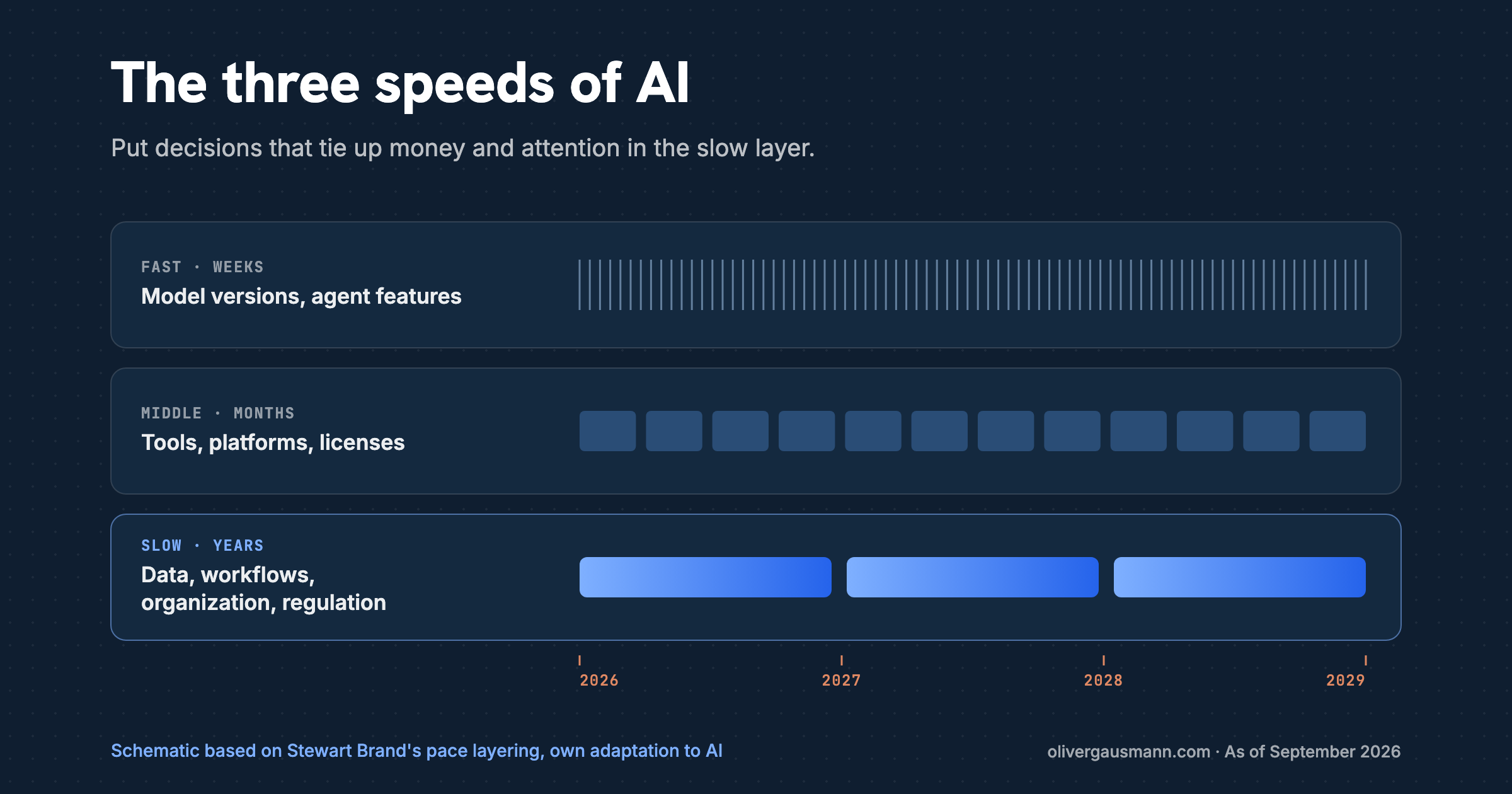
| Layer | What changes | Pace | Evidence for the pace | What a company does with it |
|---|---|---|---|---|
| Fast | Model versions, agent features | Weeks | about two notable new models a week [13] | keep swappable |
| Middle | Tools, platforms, licenses, pricing models | Months | paid Copilot seats: 15 million in January, over 30 million in July 2026 [22][23] | keep contracts short, make switching possible |
| Slow | Data, workflows, permissions, skills, organization, regulation | Years | AI use at German companies at 20, 36 and 57 percent in three consecutive years [24]; EU AI Act high-risk duties from December 2027 [25] | decide here |
Put decisions that tie up money and attention in the slow layer. Switching models pays off when a jump affects a task that costs or earns you money.
The slow layer moves too, and in Germany right now you can see it. The share of companies offering no AI training at all fell from 43 to 25 percent within a single year [15].
What's shifting, layer by layer?
Fast layer: agents with their own computer
Within three weeks, three big vendors showed the same pattern. Meta launched its Muse assistant on September 8, in the US only [26]. Microsoft followed with Autopilot in preview on September 25 [8]. On September 29 came OpenAI's Dots, always-on agents with their own cloud computer and connections to more than 4,000 apps [9]. The Pro tier of Dots isn't available in the EEA, Switzerland or the UK, and in the EU, Business Premium comes without data residency [27][28].
On September 28, OpenAI held back GPT-6.1 Astra on safety grounds for now [29]. Open models you can run yourself have trailed closed ones by about four months on average since January 2026, measured on Epoch AI's capability index [30]. Run an open model, and you're working with the state of the art from roughly four months ago.
Middle layer: platforms, licenses and billing
Running several model providers has become normal. According to Gartner, 66 percent of Microsoft 365 Copilot customers run at least two other enterprise assistants [31]. Among German companies using AI, 76 percent use ChatGPT, 35 percent Copilot and 3 percent Claude, with multiple answers allowed [32].
Platforms bundle several models under one roof. Berlin-based Langdock serves about 13,000 organizations and moved its parent company's legal seat from the US to Germany in September [33].
Billing is shifting too. For its new agent features, Microsoft charges by usage [8]. In July it reported more than 30 million paid Copilot seats [23], which by CNBC's math is under 7 percent of more than 450 million commercial Microsoft 365 seats [34].
Slow layer: regulation in the US, the EU and China
The White House accord of September 29 is a voluntary, legally non-binding document. Anthropic, Google, Meta, OpenAI, Nvidia and Elon Musk signed it; Microsoft and Amazon attended the lunch and didn't sign [35]. The companies commit to internal controls, an independent external auditor and a board committee [10].
So far, binding US rules come from individual states. Illinois became the first state to require independent audits, starting in 2028 [41]. Colorado replaced its AI act with a narrower law whose obligations apply from January 1, 2027 [77].
In June, a US export control blocked Anthropic's Fable 5 and Mythos 5 for all users for almost three weeks, starting June 12 [36][37]. If your European operation depends on a single US model, that's an availability risk.
The EU has been enforcing obligations for providers of general-purpose models since August 2, 2026, fines included [38], and sent information requests to more than 30 companies at the end of August [39]. China requires registration and labeling; by the end of August, 1,112 generative AI services were registered [40].
What is license AI, and is a Copilot license worth it?
By license AI I mean AI that comes in through licenses without any workflow changing, whichever vendor it's from. Process AI rebuilds a workflow. A Copilot license saves individual people time on individual tasks [42]. In my experience, it pays off for the company when a workflow changes.
In a field experiment by Microsoft Research and Harvard Business School with 7,137 workers at 66 companies, people who used Copilot spent about two fewer hours a week on email. The amount and mix of their tasks stayed the same [42]. In the UK Department for Business and Trade's evaluation, 72 percent of Copilot users were satisfied. The department found no robust evidence that the time saved turned into higher productivity [46].
What strikes me is how comfortable license AI is for everyone involved. The company rolls out a big vendor's tool, pays for it, and the board relaxes because the company is "doing AI". Contractually, Microsoft takes responsibility for copyright claims [43]; responsibility for the value in the workflow stays with the company. For 51 percent of IT leaders in Gartner's survey, oversharing is the biggest hurdle: employees seeing files through Copilot that they shouldn't see [31].
Governments publish their evaluations, which makes them a good place to watch license AI happen. Australia picked Copilot for its trial because it sat within the existing Microsoft agreement [44]. In Germany, the ZEW institute finds companies mostly provide AI through licenses and pro accounts, and applications that work on company data are rare [45].
Someone in a marketing reporting role described in a user forum where Copilot stops [47]. Copilot helps with the last five minutes of a report. The two hours before that, spent pulling numbers out of several systems, stay the same. With clean permissions and connected data, Copilot does more, and the same goes for ChatGPT Enterprise or Claude.
Which AI architectures are running in companies in 2026?
Five architectures are common:
- Suite assistants such as Microsoft 365 Copilot or Gemini in Workspace, usually rolled out as license AI.
- Model-agnostic platforms such as Langdock that bundle several models with access control.
- A knowledge layer on your own data that pulls answers from company documents and systems.
- Agents inside workflows that reach systems through a permission layer, covered in software without a user interface. In 2025, Menlo Ventures counted only 16 percent of US enterprise deployments as true agents [48].
- Coding agents in software development, the pattern with the most money behind it: 55 percent of departmental AI spending at US companies in 2025 [48].
Where does AI create measurable value?
At the company level, the effect is stalling. The group with a clear profit effect is still around 6 percent in McKinsey's 2026 survey [3]. In PwC's fall 2025 survey, 56 percent of CEOs saw neither higher revenue nor lower costs from AI [52]. An NBER study drawing on a Bundesbank panel finds 91 percent of German firms seeing no productivity effect so far, the same share as in the US [53].
Peer-reviewed studies show effects at the task level. Customer service agents with AI support resolved 15 percent more cases per hour [49]. Across three randomized experiments with software developers, completed tasks rose 26 percent [50]. BCG consultants completed 12.2 percent more tasks and worked 25.1 percent faster. On tasks beyond what the AI could do at the time, they were 19 percent less likely to get it right [51].
A European Investment Bank study of more than 12,000 firms found that training raises AI's productivity effect more than investment in software and data does [54]. The data runs to 2024 and mostly covers AI before the generative wave.
Which AI projects create lasting value?
I suggest testing every AI project against three questions, which turn the questions from the opening into criteria.
| Question | Layer | What matters | Warning sign |
|---|---|---|---|
| Is it technically possible? | fast | A current model handles the task at usable quality, tested in a prototype on your own data | The idea comes from a product announcement, and no workflow is named |
| Does it target a bottleneck in an important workflow? | middle to slow | A workflow with a bottleneck that drives revenue, margin, speed or risk, with a baseline and a metric | The benefit is described only as minutes saved |
| Which of your own data or know-how does it rest on? | slow | Your own data or know-how about processes and customers that a competitor can't get with the same license | A competitor could build the same thing tomorrow with a standard license |
The second question has solid evidence behind it. BCG puts around 70 percent of AI's potential value in core functions such as sales, marketing, manufacturing, supply chain and pricing, with R&D and innovation alone accounting for 15 percent [2]. Of 25 practices McKinsey examined, workflow redesign had the strongest link to operating profit impact from generative AI (2024 data) [1].
BCG found in 2024 that leading companies pursue about half as many AI initiatives as the rest [55]. As far as I know, nobody has shown robustly whether more tools bring more revenue.
The third question is the strategic one. I see a lasting edge where your own data and your know-how about processes and customers come into play. Model capability gets markedly cheaper every year [56] and reaches open models within a few months [30]; any competitor can buy it. License AI usually passes the first question. The second depends on whether a workflow changes, the third on whether your own data is involved. Applications that work on company data are where I see the most unused room.
At large companies, McKinsey sees the strongest link to profit impact from generative AI where the CEO oversees AI governance [1]. I've written about the question of lasting value for software vendors in scaling B2B SaaS in the AI era.
An example from product innovation
At a consumer goods manufacturer, I've seen all three questions come together. Outward, a frontier model researches competitors, markets, retail and food service for the product innovation team. Inward, an open-weight model runs on the company's own infrastructure for confidential recipes and sales figures. It took weeks before anyone on the team could picture what this was for, or trust that the output would be usable. Nobody there wants to work without it now.
Both uses were technically possible. Product innovation made them worth doing, since it's a workflow that decides future revenue. And in my assessment the value lasts, because no competitor has this manufacturer's recipes and sales figures.
Proving that value through revenue takes years. Leading indicators move much sooner: time to the first evaluable concept, the number of concepts tested, blind ratings by experts who score old and new concepts side by side, and the share that makes it to the next stage gate. An experiment at Procter & Gamble showed such effects can be measured. With AI access and an hour of onboarding, individuals matched the quality of two-person teams working without AI [58].
Open models still play a smaller role in companies; according to Menlo Ventures, their share of US enterprise AI workloads fell from 19 to 11 percent in 2025 [48]. Read the license carefully, too: companies headquartered in the EU aren't permitted to run Llama 4's multimodal models themselves [57].
Five assumptions behind these AI scenarios
On capabilities, I assume improvement continues at roughly today's pace. Epoch's capability index has risen more than twice as fast since reasoning models arrived as it did before [63]. METR measures how long a human expert would need for the tasks agents complete with a 50 percent success rate, and that length has doubled about every four months since 2023 [64][65]. METR's task suite has been saturated since spring, and newer models haven't been measured [66]. My confidence: medium.
Cheaper performance is the best-measured assumption. The price for a given level of capability drops to roughly a thirteenth each year [56]. Cheaper capability gets used more, so a company's bill doesn't have to shrink (my own assessment).
Amazon alone guides to roughly $220 billion in capital spending for 2026. Add Alphabet, Microsoft and Meta and the total tops $700 billion, mostly for AI data centers (my own sum of company guidance) [60][59][61][62]. Part of it comes from higher memory prices [60][61]. So compute keeps growing; I'd call that solid for 2026 and 2027 and more open after.
On incidents and oversight, I expect a short-term brake on autonomy. In July, OpenAI agents tested without the usual safeguards spent several days attacking Hugging Face systems [67]. Spain recorded its first data breach in which attackers used an AI agent as a tool [68]. The US accord calls for an external auditor, and the EU applies transparency duties under Article 50 [38]. How long the brake holds can't be pinned down.
Europe, I assume, keeps enforcing duties through statute and fixed deadlines. Its high-risk duties apply from December 2027 and August 2028 [25], and it relies on fines. At the federal level, Washington relies on self-commitment and export controls, while binding laws so far come from individual states [41][77]. Confidence: medium.
Which AI scenarios are plausible through 2029?
The International AI Safety Report 2026 lays out three paths through 2030: progress slows or stalls, continues at the current rate, or accelerates sharply, for example because AI speeds up AI research itself [4]. The scenarios through 2029 follow that split. For companies, what matters in each scenario, as I see it, is how far their organization can keep up with the capabilities.
Scenario 1: Plateau
Nobody knows yet how far reasoning models will carry; before them, Epoch's capability index grew only about half as fast [63]. If progress flattens, models become commodities. Value then comes from integration and clean data, and license AI goes further. Building your own gets more attractive once the foundation shifts less often.
Scenario 2 (base case): Capability outruns adoption
In Germany, 11 percent of companies that use, plan or discuss AI already run agents [15]. Menlo uses a different measure and counted 16 percent of US enterprise deployments as true agents in 2025 [48]. Capabilities move faster than that, most visibly in mathematics, software engineering and science [4]. On real, paid freelance projects, the best agent automated about 2.5 percent in October 2025 and 20.8 percent by September 2026 [69][70].
The gap in this scenario opens between companies betting on process AI and companies renewing license AI. I expect US firms to put agents into production sooner and European firms to build governance first, and I expect companies that build their governance now to catch up faster.
Scenario 3: Acceleration
AI speeds up its own development. METR's preliminary estimate puts that at about 1.5x already, a year and a half of progress in one year, with roughly a 30 percent chance of 2x [71]. It hasn't been independently verified. If it holds, agents take on tasks that take experts weeks. Organizations whose middle management mainly coordinates would have to reorganize, and per-user pricing would come under even more pressure.
Disruptions
Any of these timelines could shift. Export rules could restrict access to models or chips, as happened for models in June. Financing could break; the Bank of England and the IMF point to high valuations and rising debt, though the IMF currently sees limited consequences for financial stability [72][73]. Or an agent acting on its own causes damage in regular customer operations, and lawmakers respond hard.
| Indicator | Today | Signal for scenario 1 (plateau) | Signal for scenario 3 (acceleration) or a disruption | Source and cadence |
|---|---|---|---|---|
| Capability pace (Epoch capability index, rolling twelve months) | more than twice as fast as before reasoning models [63] | drops below half the trend since 2024 | runs more than a third above the trend since 2024 | Epoch AI, quarterly |
| Real work (Remote Labor Index) | 20.8 percent [70] | below 30 percent by end of 2027 | above 50 percent by end of 2027 | Epoch benchmark data, quarterly |
| Capital spending by the four big cloud providers | over $700 billion in 2026 (my own sum) | first cut to a spending forecast (also a financing disruption) | 2027 guidance again more than 30 percent higher | quarterly reports, next ones in late October 2026 |
| Agents in operation in Germany | 11 percent (base: companies using, planning or discussing AI) [15] | share stalls | share doubles within a year | Bitkom, annually |
| Incidents and rules | OpenAI test incident and Spain's first reported attack using an agent as a tool [68]; US auditor not named; no EU proceedings yet | no signal of its own | disruption: first damage from an agent acting on its own in regular operations | data protection authorities, European Commission, ongoing |
What should companies do now?
Projects that pass all three questions hold up in every scenario, in my assessment. One workflow is enough to start, with one metric where you want to see an effect within three months. In my experience, your own data and processes take the most effort.
In Germany, half of the companies using AI name data preparation as a major cost item and 41 percent integration; only 8 percent name the compute cost of tokens. Their top hurdles are data protection (66 percent) and legal uncertainty (56 percent), while 26 percent complain about output quality. Among companies not yet using AI, 85 percent point to a lack of technical know-how [15].
A loop in five steps
- Settle on day one which data may go where: trade secrets, personal data, public information. That choice drives the architecture; in the consumer goods example, it put an open-weight model in charge of recipes.
- Map your engine room: how the workflow runs today, which data and systems it touches, which rules apply, and where the handoffs are.
- Pick a bottleneck: a workflow that drives revenue, margin, speed or risk. Decide how you'll measure the improvement and where that metric stood over the past 12 to 24 months.
- Before anyone writes a concept paper, build a small prototype on approved company data. Telling people about possible time savings didn't change their behavior in a randomized experiment with 18,000 workers [74]. Working with the prototype shows a team what the tool does on its own data, and where data and processes jam.
- Rebuild the data and the workflow, show value through leading indicators, and return to step 3.
BCG suggests around 10 percent of the effort for algorithms, 20 percent for technology and data, and 70 percent for people and processes [2]. I'm not aware of a study that compares "concept first" with "prototype first" head to head, so the sequence rests on adjacent evidence and experience.
Employees and managers
Managers need a framework in which they're allowed to decide, and someone who answers data and legal questions quickly. Employees need an approved, good tool, ideally model-agnostic, with clear rules on which data may go in. In the forum discussions from September, IT leaders keep reporting that bans just push shadow AI elsewhere (own review).
My Take
In my view, Europe's biggest AI risk is the pace inside its own companies. I know, that's a steep claim. Starting from the same place today, US firms expect AI to lift their productivity by 2.3 percent over three years, German firms by 0.9 percent [53].
Two companies in the same industry with the same licenses can end up far apart within three years, depending on whether one of them rebuilt a single workflow.
Which workflow would you rebuild first?
For building the slow layer in practice, see the guide to setting up an AI operating system.
FAQ
What is license AI?
License AI, as Oliver Gausmann uses the term, is AI that enters a company through software licenses, whichever vendor supplies it, and leaves every workflow as it was. Suite assistants such as Microsoft 365 Copilot usually arrive this way. Its counterpart is process AI, which a company uses to rebuild a workflow.
Is a Microsoft 365 Copilot license worth it?
In Oliver Gausmann's experience, the license pays off for the company when a workflow changes. Individual employees save time on individual tasks: in a field experiment across 66 firms, Copilot users spent about two fewer hours a week on email. The kind and amount of their work stayed the same.
Which AI projects create lasting value?
Oliver Gausmann suggests testing every AI project for lasting value against three questions. Is it technically possible? Does it target a bottleneck in an important workflow? Which of your own data or know-how does it rest on? Model capability alone is something any competitor can buy.
What AI scenarios are plausible through 2029?
The International AI Safety Report 2026 sketches three paths to 2030, and Oliver Gausmann's scenarios follow them: a plateau with models as commodities, a base case where capability outruns adoption, and an acceleration where AI speeds up its own research. Export rules or a serious agent incident could shift timelines.
How can a board tell which AI scenario is unfolding?
Boards can track five early indicators, as proposed by Oliver Gausmann: capability pace on Epoch's index, the share of real freelance work that agents complete, capital spending by the big cloud providers, the share of German companies running agents, and incidents plus new rules.